The north bank of the Liffey
 Our view
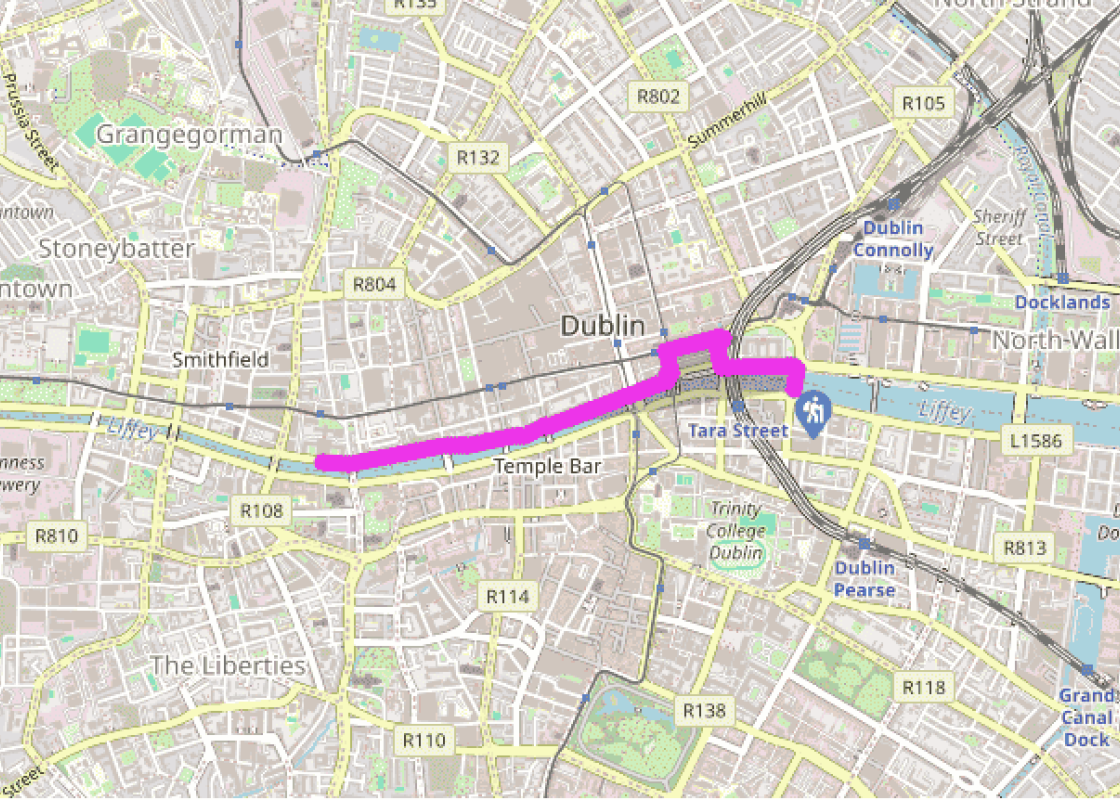
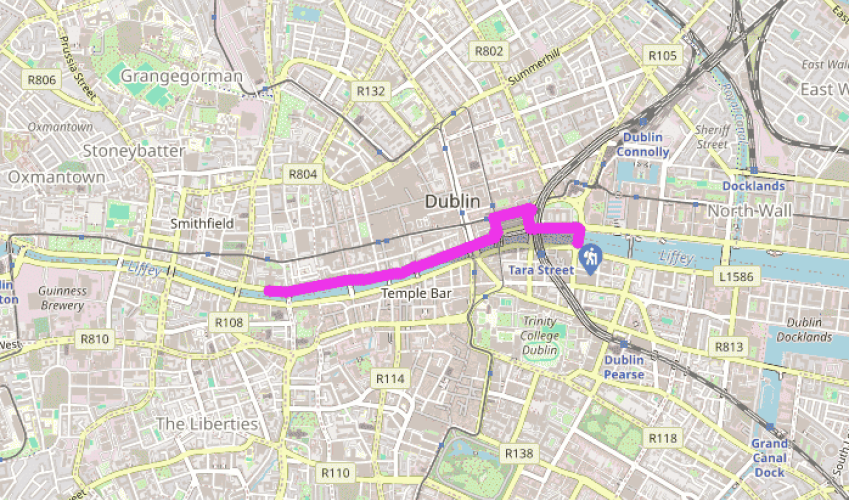
Start this walk on the south side of the Talbot Memorial Bridge, and look across and a little to your left to the remarkable façade of the Custom House. This grand building with its verdigris copper dome, crowned by an allegorical statue of Commerce, is one of the triumphs of English architect James Gandon. Its history has not been happy. It became redundant only nine years after it was built, when Ireland’s parliament was merged with Britain’s and the customs and revenue offices moved to London. Through the 19th century it became more dilapidated, and in 1921 Sinn Fein firebrands administered the coup de grâce. The hated symbol of British rule burned for five days, and although it was patched up in the mid-1920s the building was not fully restored until 1991. Since then, it has housed various government departments.Cross the bridge and turn right along Custom House Quay, passing the Famine Memorial on the right. The potato has been both a blessing and a curse to Ireland. When it was introduced from America in the 17th century, it provided a cheap, plentiful and nourishing staple – so much so that by the 19th century many Irish families ate almost nothing else. When potato blight destroyed the entire crop, an estimated one million people starved to death. This was the Great Famine of 1845–48. Most of the deaths could have been prevented, but the British government was slow to lift taxes and release stocks of grain (of which there was plenty) to feed the starving. Ireland’s population fell by half over the next few decades, as millions of people emigrated to England, Scotland and America, and the number of people living in Ireland today is still well below the pre-famine level. Many of the people driven from their rural homes by hunger got no further than the Dublin slums, altering the character of the city forever.
Leave the memorial and walk back to pass the Talbot Memorial Bridge and follow the north side of the quay. Take the next right after Custom House, called Beresford Place. Cross the street, pass Old Abbey Street on the left and take the next left into Abbey Street Lower. Ireland’s national theatre is on the left side of the street at No. 26. Ireland’s 20th-century cultural renaissance began with the founding of the Abbey Theatre in 1904, by William Butler Yeats, Ireland’s most famous poet, and his amanuensis, Lady Augusta Gregory. Many of the works first performed here – by playwrights including J. M. Synge, Sean O’Casey, Oscar Wilde, and more recently Brian Friel and Hugh Leonard – have been controversial. Sadly, in 1951 a fire destroyed the original theatre building and it took until 1966 for the theatre to re-open in a new building on the same site. Plans to relocate the Abbey Theatre to the Waterfront District were shelved in 2010 – much to the delight of this historic theatre’s followers.

Been on this walk?
Send us photos or a comment about this route. Or recommend a route of your own.

Walking in Safety
Read our tips to look after yourself and the environment when following this walk.
Get an AA guide
Explore our range of ‘50 Walks in’ guides - they’re the ideal companion for a ramble.
Been on this walk?
Send us photos or a comment about this route. Or recommend a route of your own.
Walking in Safety
Read our tips to look after yourself and the environment when following this walk.
Get an AA guide
Explore our range of ‘50 Walks in’ guides - they’re the ideal companion for a ramble.
Nearby places to stay
View all (3)
- Family rooms: 0

- En-suite rooms:
- Family rooms: