Pembrokeshire Coast Path: Whitesands Bay to Trefin
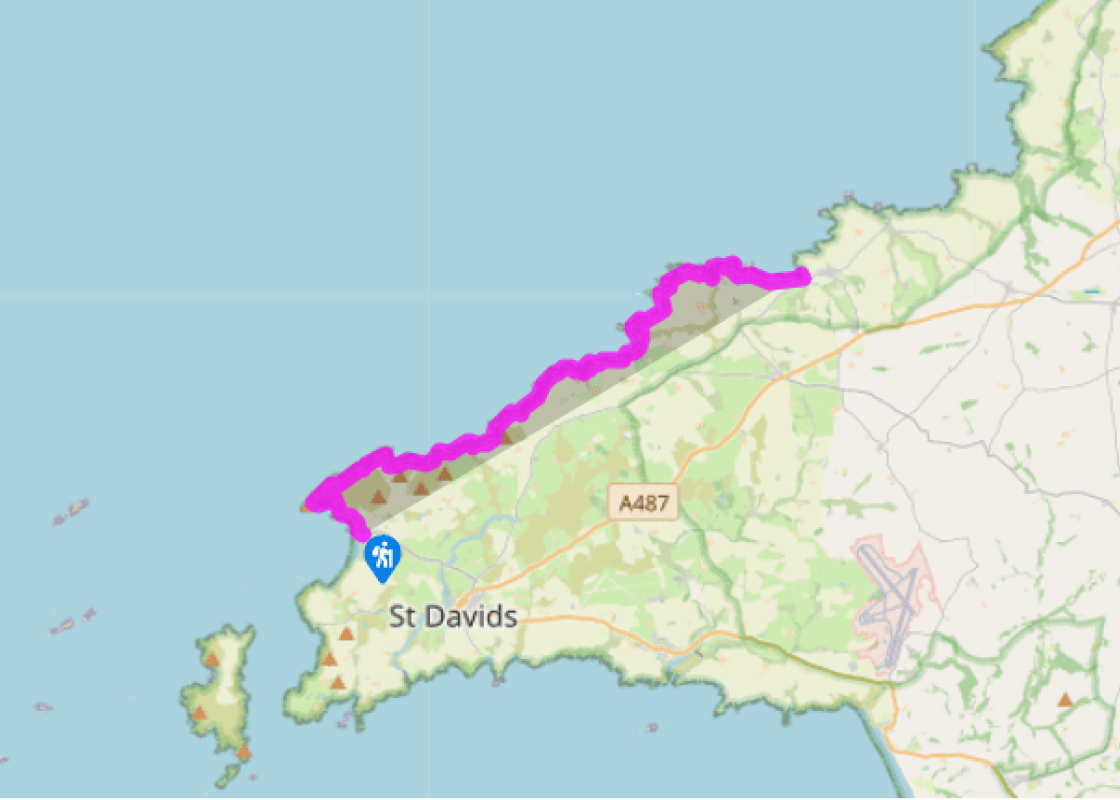
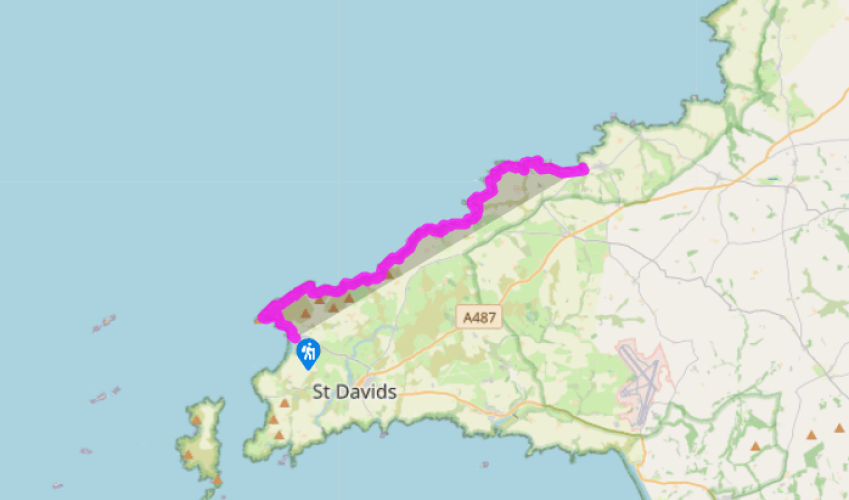
From the Whitesands car park, the coast path continues northwards, gaining height and passing the beach at Porthmelgan, close to St David’s Head. This is the last beach that is accessible from the land until Abereiddy Bay. Inland, the heather-covered headland is dominated by Carn Llidi; one of the Ordovician volcanic peaks of this wild area, which is mainly populated by seabirds, wild flowers, and other walkers. St David’s Head sticks out to the west here, described by the ancient geographer Ptolemy as the Promontory of Eight Perils, because of its fatal attraction for early sail-powered ships, driven on to this unforgiving shore by relentless westerly winds.
The route continues eastwards, following the cliff-tops all the way, with fine views along the coastline ahead. The path is a good way from the road here, with few connecting footpaths and little habitation apart from the occasional inland farm.

Past the banks of the three Iron Age forts at Caerau, the path drops to sea level once again at west-facing Abereiddy Bay, popular with the more adventurous holidaymaker who is willing to go further
afield. Back on the cliffs, on the north side of the beach, pass the remains of a slate quarry that was operational until 1910, with ruins of the quarrymen’s row, engine house and dressing sheds. Most impressive is the flooded quarry, cut deep into the cliff-face of the headland. It is now known as The Blue Lagoon, with a deep entrance wide enough for a single boat. The stone tower above may have been built to aid navigation in the 18th century, and is a useful landmark for walkers today.
The next beach is Traeth Llyfn, accessible via a steep path. The coast path follows the cliff-tops until it descends steeply to Porthgain; an inlet with a fascinating small harbour, once busily engaged in the export of slates brought by tramway from Abereiddy. After 100 years or so, trade ceased in 1931 and all that is left are the massive old brickworks and bins for the crushed stone. With a few fishing boats, a pub, an award-winning seafood restaurant and a green with picnic tables, Porthgain has a welcoming
air today.
On the far side of the harbour, the coast path continues up past an old navigational tower, dropping to sea level once again at Aber Draw, where the path joins the road. Here the walker can continue downhill and uphill along the road into Trefin, or better, turn off to the left to rejoin the coast path by a rather untidy small bay, passing a row of cream-painted cottages to reach the next headland. From here, a footpath heads inland to join a farm track which leads into Trefin (pronounced ‘tre-veen’). The path is fenced on both sides, but care needs to be taken to find it. If you go beyond the headland and start turning in towards the next bay at Pwll Olfa, you have gone too far. Nearby Trefin is an unexciting place to finish, but it has a pub, a campsite, and a hostel where you can break the journey. Alternatively, some walkers may prefer to stop at Porthgain or push on to equally picturesque Abercastle.
Been on this walk?
Send us photos or a comment about this route. Or recommend a route of your own.

Walking in Safety
Read our tips to look after yourself and the environment when following this walk.
Get an AA guide
Explore our range of ‘50 Walks in’ guides - they’re the ideal companion for a ramble.
Been on this walk?
Send us photos or a comment about this route. Or recommend a route of your own.
Walking in Safety
Read our tips to look after yourself and the environment when following this walk.
Get an AA guide
Explore our range of ‘50 Walks in’ guides - they’re the ideal companion for a ramble.
Nearby places to stay
View all (8)

- Rooms 8
- Rooms 4
- Free TV
- Wifi
- Open parking
- Rooms 9
- Free TV
- Wifi
- Open parking