Dublin's heroes of independence
 Our view
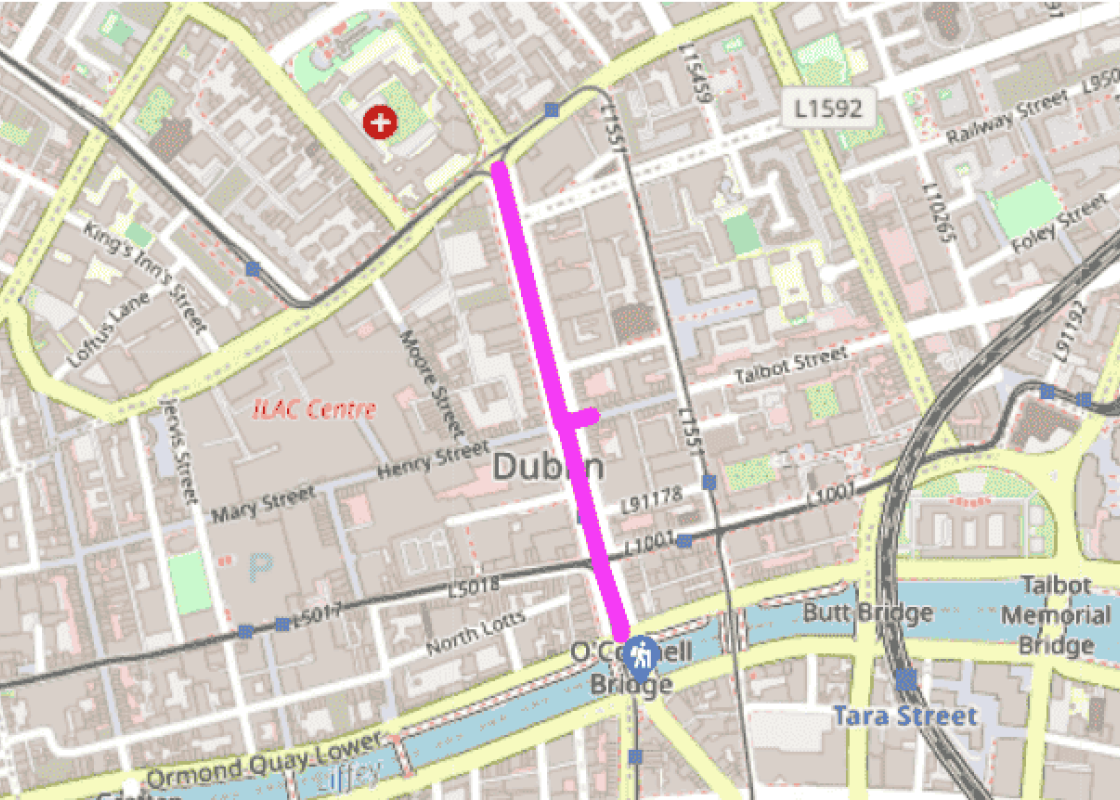
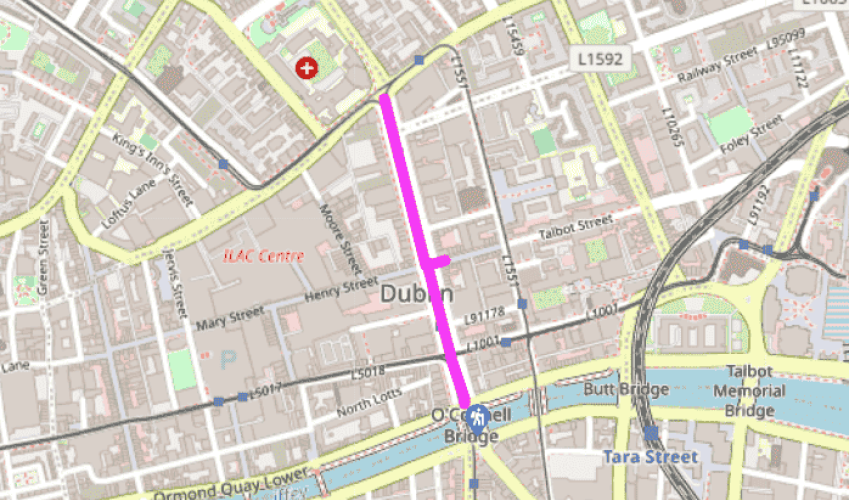
From the bus stop next to the River Liffey, at the corner of D’Olier Street and Burgh Quay, turn about to face the river and walk north across O’Connell Bridge. On your right, downriver, is the great copper dome of the Custom House, crowned by an allegorical bronze statue of Commerce. On your left, upriver, is the Liffey Bridge, commonly known as Ha’penny Bridge because when it was built in 1816 a halfpenny was charged to walk across it. Ahead of you, at the foot of O’Connell Street on the left, a statue of Daniel O’Connell, ‘the Liberator’ (1775–1847), dominates the proceedings. O’Connell was the first great non-violent agitator against the Union of Britain and Ireland. Though a fiery orator, he advocated peaceful mass protest in place of violent resistance to British rule, and condemned the rebellion of 1803 led by Robert Emmett. Elected to the Irish Parliament in 1828, O’Connell was barred from taking his place as an MP because of his Catholic faith. The mass protests that followed led in 1829 to the Catholic Emancipation Act, allowing the election of Catholics. In 1841 he became the first Catholic mayor of Dublin. In 1844, now almost 70 years old, he was convicted of conspiracy and jailed for a year after calling a huge rally to demand repeal of the Union. Though released after three months, O’Connell became deeply disenchanted at the failure of his life-long campaign of peaceful opposition. A sick man, he left Dublin for sunnier Italy in 1847, but died soon after arriving in Genoa. The foundation stone of the statue was laid in 1864, but the statue itself, designed and begun by John Foley, but completed by his assistant Thomas Brock, was finally unveiled on 15 August 1882.
.
Leaving the statue behind, carry on up the left-hand side of O’Connell Street to the corner of Abbey Street Middle. Cross Abbey Street, and just on your right is a statue to a hero of the international trade union movement and the Left in Ireland. James ‘Big Jim’ Larkin (1874–1947) was born of Irish parents in Liverpool and grew up in the city’s slums. A dockworker and trade union activist, he came to Dublin in 1908 to set up the Irish Transport and General Workers’ Union (ITGWU). In 1913 he led a long and bitter dispute with the Dublin United Tramway Company after its owner tried to break the union by sacking its members. After seven months, the strikers were forced to return to work, but their action became a landmark in the history of organized labour in Ireland. Larkin left for the US, where he became a keen supporter of the new Union of Soviet Socialist Republics and was sentenced to five years in jail on trumped-up charges of ‘criminal anarchy’. Deported from the US, he returned to Ireland in 1923 and set up the communist Irish Workers’ League. In 1927 he became the first communist to be elected to the Dáil (lower house of Parliament). He moved away from Soviet-style communism, but he remained a man of the Left until his death in 1947. On the plinth of his statue, erected in 1980, is a quote (in French, Irish and English) from one of his speeches: ‘The great appear great only because we are on our knees. Let us rise.’ The slogan and the sentiment are borrowed from Camille Demoulins, one of the firebrands of the French Revolution.

Been on this walk?
Send us photos or a comment about this route. Or recommend a route of your own.

Walking in Safety
Read our tips to look after yourself and the environment when following this walk.
Get an AA guide
Explore our range of ‘50 Walks in’ guides - they’re the ideal companion for a ramble.
Been on this walk?
Send us photos or a comment about this route. Or recommend a route of your own.
Walking in Safety
Read our tips to look after yourself and the environment when following this walk.
Get an AA guide
Explore our range of ‘50 Walks in’ guides - they’re the ideal companion for a ramble.
Nearby places to stay
View all (3)
- Family rooms: 0

- En-suite rooms:
- Family rooms: